
By Dr. N.S. Rajaram
There is a great deal of confusion over the origins of the Aryan invasion theory and even the word Arya. It explains also the use and misuse of the word.
Aryans: race or culture?
 The evidence of science now points to two basic conclusions: first, there was no Aryan invasion, and second, the Rigvedic people were already established in India no later than 4000 BCE. How are we then to account for the continued presence of the Aryan invasion version of history in history books and encyclopedias even today?
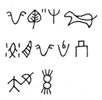 Some of the results - like Jha's decipherment of the Indus script - are relatively recent, and it is probably unrealistic to expect history books to reflect all the latest findings. But unfortunately, influential Indian historians and educators continue to resist all revisions and hold on to this racist creation - the Aryan invasion theory. Though there is now a tendency to treat the Aryan-Dravidian division as a linguistic phenomenon, its roots are decidedly racial and political, as we shall soon discover.
 Speaking of the Aryan invasion theory, it would probably be an oversimplification to say: "Germans invented it, British used it," but not by much. The concept of the Aryans as a race and the associated idea of the 'Aryan nation' were very much a part of the ideology of German nationalism. For reasons known only to them, Indian educational authorities have continued to propagate this obsolete fiction that degrades and divides her people. They have allowed their political biases and career interests to take precedence over the education of children. They continue to propagate a version that has no scientific basis.
 Before getting to the role played by German nationalism, it is useful first to take a brief look at what the word Arya does mean. After Hitler and the Nazi atrocities, most people, especially Europeans, are understandably reluctant to be reminded of the word. But that was a European crime; Indians had no part in it. The real Aryans have lived in India for thousands of years without committing anything remotely resembling the Nazi horrors. So there is no need to be diffident in examining the origins of the European misuse of the word. In any event, history demands it.
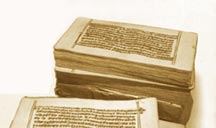 The first point to note is that the idea of the Aryans as foreigners who invaded India and destroyed the existing Harappan Civilization is a modern European invention; it receives no support whatsoever from Indian records - literary or archaeological. The same is true of the notion of the Aryans as a race; it finds no support in Indian literature or tradition. The word 'Arya' in Sanskrit means noble and never a race. In fact, the authoritative Sanskrit lexicon (c. 450 AD), the famous Amarakosa
gives the following definition:
The first point to note is that the idea of the Aryans as foreigners who invaded India and destroyed the existing Harappan Civilization is a modern European invention; it receives no support whatsoever from Indian records - literary or archaeological. The same is true of the notion of the Aryans as a race; it finds no support in Indian literature or tradition. The word 'Arya' in Sanskrit means noble and never a race. In fact, the authoritative Sanskrit lexicon (c. 450 AD), the famous Amarakosa
gives the following definition:
mahakula kulinarya sabhya sajjana sadhavah
An Arya is one who hails from a noble family, of gentle behavior and demeanor, good-natured and of righteous conduct
And the great epic Ramayana has a singularly eloquent expression describing Rama as:
arya sarva samascaiva sadaiva priyadarsanah
Arya, who worked for the equality of all and was dear to everyone.
The Rigveda also uses the word Arya something like thirty six times, but never to mean a race. The nearest to a definition that one can find in the Rigveda is probably:
praja arya jyotiragrah ... (Children of Arya are led by light)RV, VII. 33.17
The word 'light' should be taken in the spiritual sense to mean enlightenment. The word Arya, according to those who originated the term, is to be used to describe those people who observed a code of conduct; people were Aryans or non-Aryans depending on whether or not they followed this code. This is made entirely clear in the Manudharma Shastra or the Manusmriti (X.43-45):
But in consequence of the omission of sacred rites, and of their not heeding the sages, the following people of the noble class [Arya Kshatriyas] have gradually sunk to the state of servants - the Paundrakas, Chodas, Dravidas, Kambojas, Yavanas, Shakhas, Paradhas, Pahlavas, Chinas, Kiratas and Daradas.
 Two points about this list are worth noting: first, their fall from the Aryan fold had nothing to do with race, birth or nationality; it was due entirely to their failure to follow certain sacred rites. Second, the list includes people from all parts of India as well as a few neighboring countries like China and Persia (Pahlavas). Kambojas are from West Punjab, Yavanas from Afghanistan and beyond (not necessarily the Greeks) while Dravidas refers probably to people from the southwest of India and the South.
Thus, the modern notion of an Aryan-Dravidian racial divide is contradicted by ancient records. We have it on the authority of Manu that the Dravidians were also part of the Aryan fold. Interestingly, so were the Chinese. Race never had anything to do with it until the Europeans adopted the ancient word to give expression to their nationalistic and other aspirations.
Scientists have known this for quite some time. Julian Huxley, one of the leading biologists of the century, wrote as far back as 1939:
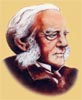
 In 1848 the young German scholar Friedrich Max Muller (1823-1900) settled in Oxford, where he remained for the rest of his life. ... About 1853 he introduced into the English language the unlucky term Aryan as applied to a large group of languages. ...
Moreover, Max Muller threw another apple of discord. He introduced a proposition that is demonstrably false. He spoke not only of a definite Aryan language and its descendents, but also of a corresponding 'Aryan race'. The idea was rapidly taken up both in Germany and in England. It affected to some extent a certain number of the nationalistic and romantic writers, none of whom had any ethnological training. ...
 In England and America the phrase 'Aryan race' has quite ceased to be used by writers with scientific knowledge, though it appears occasionally in political and propagandist literature. In Germany the idea of the 'Aryan' race found no more scientific support than in England. Nonetheless, it found able and very persistent literary advocates who made it very flattering to local vanity. It therefore spread, fostered by special conditions.
This should help settle the issue as far as its modern misuse is concerned. As far as ancient India is concerned, one may safely say that the word Arya denoted certain spiritual and humanistic values that defined her civilization. The entire Aryan civilization - the civilization of Vedic India - was driven and sustained by these values. The whole of ancient Indian literature: from the Vedas, the Brahmanas to the Puranas to the epics like the Mahabharataand the Ramayanacan be seen as a record of the struggles of an ancient people to live up to the ideals defined by these values. Anyone regardless of birth, race or national origin could become Aryan by following this code of conduct. It was not something to be imposed upon others by the sword or by proselytization. Viewed in this light, the whole notion of any 'Aryan invasion' is an absurdity. It is like talking about an 'invasion of scientific thinking'.
Then there is also the fact that the concept of the Aryan race and the Aryan-Dravidian divide is a modern European invention that receives no support from any ancient source. To apply it to people who lived thousands of years ago is an exercise in anachronism if there ever was one.
The sum total of all this is that Indians have no reason to be defensive about the word Arya. It applies to everyone who has tried to live by the high ideals of an ancient culture regardless of race, language or nationality. It is a cultural designation of a people who created a great civilization. Anti-Semitism was an aberration of Christian European history, with its roots in the New Testament, of sayings like "He that is not with me is against me." If the Europeans (and their Indian disciples) fight shy of the word, it is their problem stemming from their history. Modern India has many things for which she has reason to be grateful to European knowledge, but this is definitely not one of them.
European currents: 'Aryan nation'
As Huxley makes clear in the passage cited earlier, the misuse of the word 'Aryan' was rooted in political propaganda aimed at appealing to local vanity. In order to understand the European misuse of the word Arya as a race, and the creation of the Aryan invasion idea, we need to go back to eighteenth and nineteenth century Europe, especially to Germany. The idea has its roots in European anti-Semitism. Recent research by scholars like Poliakov, Shaffer and others has shown that the idea of the invading Aryan race can be traced to the aspirations of eighteenth and nineteenth century Europeans to give themselves an identity that was free from the taint of Judaism.

 The Bible, as is well known, consists of two books: the Old Testament and the New Testament. The Old Testament gives the traditional history of mankind. It is of course a Jewish creation. The New Testament is also of Jewish origin; recently discovered manuscripts known as the Dead Sea Scrolls show that Christianity, in fact, began as an extremist Jewish sect. But it was turned against the Judaism of its founding fathers by religious propagandists with political ambitions. In fact, anti-Semitism first makes its appearance in the New Testament, including in the Gospels. Nonetheless, without Judaism there would be no Christianity.
To free themselves from this Jewish heritage, the intellectuals of Christian Europe looked east, to Asia. And there they saw two ancient civilizations - India and China. To them the Indian Aryans were preferable as ancestors to the Chinese. As Shaffer has observed:

 Many scholars such as Kant and Herder began to draw analogies between the myths and philosophies of ancient India and the West. In their attempt to separate Western European culture from its Judaic heritage, many scholars were convinced that the origin of Western culture was to be found in India rather than in the ancient Near East.
 So they became Aryans. But it was not the whole human race that was given this Aryan ancestry, but only a white race that came down from the mountains of Asia, subsequently became Christian and colonized Europe. No less an intellectual than Voltaire claimed to be "convinced that everything has come down to us from the banks of the Ganges - astronomy, astrology, metempsychosis, etc." (But Voltaire was emphatically not intolerant; he was in fact a strong critic of the Church of his day.)
A modern student today can scarcely have an idea of the extraordinary influence of race theories in eighteenth and nineteenth century Europe. Many educated people really believed that human qualities could be predicted on the basis of measurements of physical characteristics like eye color, length of the nose and such. It went beyond prejudice, it was an article of faith amounting to an ideology. Here is an example of what passed for informed opinion on 'race science' by the well-known French savant Paul Topinard. Much of the debate centered on the relative merits of racial types called dolichocephalics and brachycephalics, though no one seemed to have a clear idea of what was which. Anyway, here is what Topinard wrote in 1893, which should give modern readers an idea of the level of scientific thinking prevailing in those days:
The Gauls, according to history, were a people formed of two elements: the leaders or conquerors, blond, tall dolichocephalic, leptroscopes, etc. But the mass of the people, were small, relatively brachycephalic chaemeophrosopes. The brachycephalics were always oppressed. They were the victims of dolicocephalics who carried them off from their fields. ... The blond people changed from warriors into merchants and industrial workers. The brachycephalics breathed again. Being naturally prolific, their numbers [of brachycephalics] increased while the dolichocephalics naturally diminished. ... Does the future not belong to them? [Sic: Belong to whom? - dolichocephalic leptroscopes, or brachycephalic chaemeophrosopes?]
This tongue-twisting passage may sound bizarre to a modern reader, but was considered an erudite piece of reasoning when it was written. In its influence and scientific unsoundness and dogmatism, 'race science' can only be compared in this century to Marxism, especially Marxist economics. Like Marxist theories, these race theories have also been fully discredited. The emergence of molecular genetics has shown these race theories to be completely false.
By creating this pseudo-science based on race, Europeans of the Age of Enlightenment sought to free themselves from their Jewish heritage. It is interesting to note that this very same theory - of the Aryan invasion and colonization of Europe - was later applied to India and became the Aryan invasion theory of India. In reality it was nothing more than a projection into the remote past of the contemporary European experience in colonizing parts of Asia and Africa. Substituting European for Aryan, and Asian or African for Dravidian will give us a description of any of the innumerable colonial campaigns in the eighteenth or nineteenth century. According to this theory, the Aryans were carbon copies of colonizing Europeans. Seen in this light the theory is not even especially original.
The greatest effect of these ideas was on the psyche of the German people. German nationalism was the most powerful political movement of nineteenth century Europe. The idea of the Aryan race was a significant aspect of the German nationalistic movement. We are now used to regarding Germany as a rich and powerful country, but the German people at the beginning of the nineteenth century were weak and divided. There was no German nation at the time; the map of Europe then was dotted with numerous petty German principalities and dukedoms that had always been at the mercy of the neighboring great powers - Austria and France. For more than two centuries, from the time of the Thirty Years War to the Napoleonic conquests, the great powers had marched their armies through these petty German states treating these people and their rulers with utter disdain. It was very much in the interests of the French to keep the German people divided, a tactic later applied to India by the British. Every German at the time believed that he and his rulers were no more than pawns in great power rivalries. This had built up deep resentments in the hearts and minds of the German people. This was to have serious consequences for history.
In this climate of alienation and impotence, it is not surprising that German intellectuals should have sought solace in the culture of an ancient exotic land like India. Some of us can recall a very similar sentiment among Americans during the era of Vietnam and the Cold War, with many of them taking an interest in eastern religions and philosophy. These German intellectuals also felt a kinship towards India as a subjugated people, like themselves. Some of the greatest German intellectuals of the era like Humbolt, Frederick and Wilhem Schlegel, Schopenhauer and many others were students of Indian literature and philosophy.
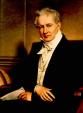



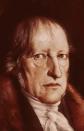 Humboldt
Friedrich Von Schlegel
Wilhelm Von Schlegel
Schopenhauer
Hegel
Humboldt
Friedrich Von Schlegel
Wilhelm Von Schlegel
Schopenhauer
Hegel
Hegel, the greatest philosopher of the age and a major influence on German nationalism was fond of saying that in philosophy and literature, Germans were the pupils of Indian sages. Humbolt went so far as to declare in 1827: "The Bhagavadgita is perhaps the loftiest and the deepest thing that the world has to show." This was the climate in Germany when it was experiencing the rising tide of nationalism.
Whereas the German involvement in things Indian was emotional and romantic, the British interest was entirely practical, even though there were scholars like Jones and Colebrooke who were admirers of India and its literature. Well before the 1857 uprising it was recognized that British rule in India could not be sustained without a large number of Indian collaborators.

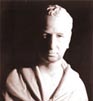
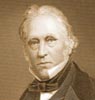 Sir William Jones
Colebrooke
Thomas Macaulay
Sir William Jones
Colebrooke
Thomas Macaulay
Recognizing this reality, influential men like Thomas Babbington Macaulay, who was Chairman of the Education Board, sought to set up an educational system modeled along British lines that would also serve to undermine the Hindu tradition. While not a missionary himself, Macaulay came from a deeply religious family steeped in the Protestant Christian faith. His father was a Presbyterian minister and his mother a Quaker. He believed that the conversion of Hindus to Christianity held the answer to the problems of administering India. His idea was to create an English educated elite that would repudiate its tradition and become British collaborators. In 1836, while serving as chairman of the Education Board in India, he enthusiastically wrote his father:
"Our English schools are flourishing wonderfully. The effect of this education on the Hindus is prodigious. ...... It is my belief that if our plans of education are followed up, there will not be a single idolator among the respectable classes in Bengal thirty years hence. And this will be effected without any efforts to proselytize, without the smallest interference with religious liberty, by natural operation of knowledge and reflection. I heartily rejoice in the project."
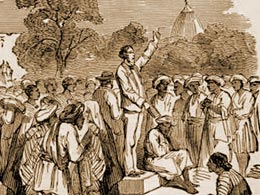 So religious conversion and colonialism were to go hand in hand. As Arun Shourie has pointed out in his recent book Missionaries in India, European Christian missions were an appendage of the colonial government, with missionaries working hand in glove with the government. In a real sense, they cannot be called religious organizations at all but an unofficial arm of the Imperial Administration. (The same is true of many Catholic missions in Central American countries who were, and probably are, in the pay of the American CIA. This was admitted by a CIA director, testifying before the Congress.)
The key point here is Macaulay's belief that 'knowledge and reflection' on the part of the Hindus, especially the Brahmins, would cause them to give up their age-old belief in favor of Christianity. In effect, his idea was to turn the strength of Hindu intellectuals against them, by utilizing their commitment to scholarship in uprooting their own tradition. His plan was to educate the Hindus to become Christians and turn them into collaborators. He was being very naive no doubt, to think that his scheme could really succeed in converting India to Christianity. At the same time it is a measure of his seriousness that Macaulay persisted with the idea for fifteen years until he found the money and the right man for turning his utopian idea into reality.
In pursuit of this goal he needed someone who would translate and interpret Indian scriptures, especially the Vedas, in such a way that the newly educated Indian elite would see the differences between them and the Bible and choose the latter. Upon his return to England, after a good deal of effort he found a talented but impoverished young German Vedic scholar by the name of Friedrich Max Muller who was willing to undertake this arduous task.
Macaulay used his influence with the East India Company to find funds for Max Muller's translation of the Rigveda. Though an ardent German nationalist, Max Muller agreed for the sake of Christianity to work for the East India Company, which in reality meant the British Government of India. He also badly needed a major sponsor for his ambitious plans, which he felt he had at last found.
This was the genesis of his great enterprise, translating the Rigveda with Sayana's commentary and the editing of the fifty-volume Sacred Books of the East. There can be no doubt at all regarding Max Muller's commitment to the conversion of Indians to Christianity. Writing to his wife in 1866 he observed:
It [the Rigveda] is the root of their religion and to show them what the root is, I feel sure, is the only way of uprooting all that has sprung from it during the last three thousand years.
Two years later he also wrote the Duke of Argyle, then acting Secretary of State for India: "The ancient religion of India is doomed. And if Christianity does not take its place, whose fault will it be?" The facts therefore are clear: like Lawrence of Arabia in this century, Max Muller, though a scholar was an agent of the British government paid to advance its colonial interests.
 But he remained an ardent German nationalist even while working in England. This helps explain why he used his position as a recognized Vedic and Sanskrit scholar to promote the idea of the 'Aryan race' and 'nation', both favorite slogans among German nationalists. Though he was later to repudiate it, it was Max Muller as much as anyone who popularized the notion of Arya as a race. This of course was to reach its culmination in the rise of Hitler and the horrors of Nazism in our own century.
Although it would be unfair to blame Max Muller for the rise of Nazism, he, as an eminent scholar of the Vedas and Sanskrit, bears a heavy responsibility for the deliberate misuse of a term in response to the emotion of the moment. He was guilty of giving scriptural sanction to the worst prejudice of his or any age. Not everyone however was guilty of such abuse. Wilhem Schlegel, no less a German nationalist, or romantic, always used the word 'Arya' to mean honorable and never in a racial sense. Max Muller's misuse of the term may be pardonable in an ignoramus, but not in a scholar of his stature.
At the same time it should be pointed out that there is nothing to indicate that Max Muller was himself a racist. He was a decent and honorable man who had many Indian friends. He simply allowed himself to be carried away by the emotion of the moment, and the heady feeling of being regarded an Aryan sage by fellow German nationalists. To be always in the public eye was a lifelong weakness with the man. With the benefit of hindsight we can say that Max Muller saw the opportunity and made a 'bargain with the devil' to gain fame and fortune. It would be a serious error however to judge the man based on this one unseemly episode in a many-sided life. His contribution as editor and publisher of ancient works is great beyond dispute. He was a great man and we must be prepared to recognize it.
Much now is made of the fact that Max Muller later repudiated the racial aspects of this theory, claiming it to be a linguistic concept. But this again owed more to winds of change in European politics than to science or scholarship. Britain had been watching the progress of German nationalism with rising anxiety that burst into near hysteria in some circles when Prussia crushed France in the Franco-Prussian war in 1871. This led to German unification under the banner of Prussia. Suddenly Germany became the most populous and powerful country in Western Europe and the greatest threat to British ambitions. Belief was widespread among British Indian authorities that India and Sanskrit studies had made a major contribution to German unification. Sir Henry Maine, a former Vice Chancellor of Calcutta university and an advisor to the Viceroy echoed the sentiment of many Englishmen when he said: "A nation has been born out of Sanskrit."
This obviously was an exaggeration, but to the British still reeling from the effects of the 1857 revolt, the specter of German unification being repeated in India was very real. Max Muller though found himself in an extremely tight spot. Though a German by birth he was now comfortably established in England, in the middle of his lifework on the Vedas and the Sacred Books of the East. His youthful flirtation with German nationalism and this race theory could now cost him dear. German unification was followed in England by an outburst of British jingoism in which Bismarck and his policies were being daily denounced; Bismarck had become extremely unpopular in England for his expansionist policies. With his background as a German nationalist, the last thing Max Muller could afford was to be seen as advocating German ideology in Victorian England. He had no choice but to repudiate his former theories simply to survive in England. He reacted by hastily propounding a new 'linguistic theory.'
So in 1872, immediately following German unification, the culmination of the century long dream of German nationalists, Friedrich Max Muller marched into a university in German occupied France and dramatically denounced the German doctrine of the Arya race. And just as he had been an upholder of this race theory for the first twenty years of his career, he was to remain a staunch opponent of it for the remaining thirty years of his life. It is primarily in the second role that he is remembered today, except by those familiar with the whole history.
Let us now take a final look at this famous theory. It was first a theory of Europe created by Europeans to free themselves from the Jewish heritage of Christianity. This was to lead to Hitler and Nazism. This theory was later transferred to India and got mixed up with the study of Sanskrit and European languages. Europeans, now calling themselves Indo-Europeans became the invading Aryas and the natives became the Dravidians. The British hired Max Muller to use this theory to turn the Vedas into an inferior scripture, to help turn educated Hindus into Christian collaborators. Max Muller used his position as a Vedic scholar to boost German nationalism by giving scriptural sanction to the German idea of the Arya race. Following German unification under Bismarck, British public and politicians became scared and anti-German. At this Max Muller, worried about his position in England, got cold feet and wriggled out of his predicament by denouncing his own former racial theory and turned it into a linguistic theory. In all of this, one would like to know where was the science?
 As Huxley pointed out long ago, there was never any scientific basis for the Arya race or their incursion. It was entirely a product - and tool - of propagandists and politicians. Giving it a linguistic twist was simply an afterthought, dictated by special circumstances and expediency.
 The fact that Europeans should have concocted this scenario, which by repeated assertion became a belief system is not to be wondered at. They were trying to give themselves a cultural identity, entirely understandable in a people as deeply concerned about their history and origins as the modern Europeans. But how to account for the tenacious attachment to this fiction that is more propaganda than history on the part of 'establishment' Indian historians? It is not greatly to their credit that modern Indian historians - with rare exceptions - have failed to show the independence of mind necessary to subject this theory to a fresh examination and come up with a more realistic version of history. Probably they lack also the necessary scientific skills and have little choice beyond continuing along the same well-worn paths that don't demand much more than reiterating nineteenth century formulations.
It is not often that a people look to a land and culture far removed from them in space and time for their inspiration as the German nationalists did. This should make modern Indian historians examine the causes in Europe for this unusual phenomenon. It is one of the great failures of scholarship that they failed to do so.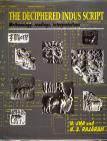
We no longer have to continue along this discredited path. Now thanks to the contributions of science — from the pioneering exploration of V.S. Wakankar and his discovery of the Vedic river Sarasvati to Jha's decipherment of the Indus script - we are finally allowed a glimpse into the ancient world of the Vedic Age. The AI theory and its creators and advocates are on their way to the dustbin of history.
Conclusion: historiography, not Indology is the answer
 The rise and fall of Indology closely parallels the growth and decline of European colonialism and the Euro-centric domination of Indian intellectual life. (Marxism is the most extreme of Euro-centric doctrines - a 'Christian heresy' as Bertrand Russell called it.) The greatest failure of Indology has been its inability to evolve an objective methodology for the study of the sources. Even after two hundred years of existence, there is no common body of knowledge that can serve as foundation, or technical tools that be used in addressing specific problems. All that Indologists have given us are theories and more theories, almost all of them borrowed from other disciplines. If one went to botany to borrow tree diagrams for the study of languages, another went to psychology to study sacrificial rituals, and a third - followed by a whole battalion - borrowed the idea of the class struggle from Marx to apply to Vedic society. Not one of them stopped to think whether it would not be better to try to study the ancients through the eyes of the ancients themselves. And yet ample materials exist to follow such a course.
With the benefit of hindsight, even setting aside irrational biases due to politics and Biblical beliefs, we can now recognize that Indology has been guilty of two fundamental methodological errors.
-
First, linguists have confused their theories - based on their own classifications and even whimsical assumptions - for fundamental laws of nature that reflect historical reality.
-
Secondly, archaeologists, at least a significant number of them, have subordinated their own interpretations to the historical, cultural, and even the chronological impositions of the linguists. (Remember the Biblical Creation in 4,004 BCE which gave this incursion in 1500 BCE!) This has resulted in a fundamental methodological error of confounding primary data from archaeology with modern impositions like the AI and other theories and even their dates.
This mixing of unlikes - further confounded by religious beliefs and political theories - is a primary source of the confusion that plagues the history and archaeology of ancient India. In their failure to investigate the sources, modern scholars - Indian scholars in particular - have much to answer for.
As an immediate consequence of this, the vast body of primary literature from the Vedic period has been completely divorced from Harappan archaeology under the dogmatic belief that the Vedas and Sanskrit came later. This has meant that this great literature and its creators have no archaeological or even geographical existence. In our view, the correct approach to breaking this deadlock is by a combination of likes - a study of primary data from archaeology alongside the primary literature from ancient periods.
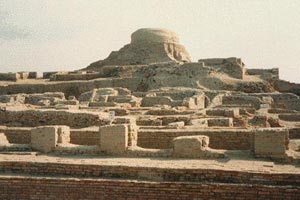
This means we must be wary of modern theories intruding upon ancient data and texts. The best course is to disregard them. They have outlived their usefulness if they had any.
In the final analysis, Indology - like the Renaissance and the Romantic Movement - should be seen as part of European history. And Indologists - from Max Muller to his modern successors - have contributed no more to the study of ancient India than Herodotus. Their works tell us more about them than about India. It is time to make a new beginning. The decipherment of the Indus script - and the scientific methodology leading up to it - can herald this new beginning.
This Article Reprinted With Permission of Author