
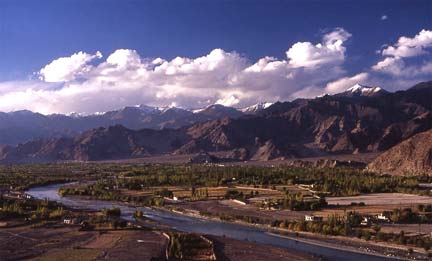
Some several thousand years ago there once thrived a civilization in the Indus Valley. Located in what's now Pakistan and western India, it was the earliest known urban culture of the Indian subcontinent. (1) The Indus Valley Civilization, as it is called, covered an area the size of western Europe. It was the largest of the four ancient civilizations of Egypt, Mesopotamia, India and China. However, of all these civilizations the least is known about the Indus Valley people. This is because the Indus script has not yet been deciphered. There are many remnants of the script on pottery vessels, seals, and amulets, but without a "Rosetta Stone" linguists and archaeologists have been unable to decipher it.
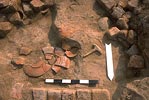
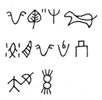
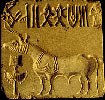
They have then had to rely upon the surviving cultural materials to give them insight into the life of the Harappan's. (2) Harappan's are the name given to any of the ancient people belonging to the Indus Valley civilization. This article will be focusing mainly on the two largest cities of Harappa and Mohenjo-Daro, and what has been discovered there.
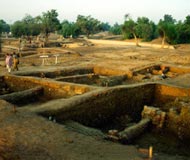 The discovery of the Indus Valley civilization was first recorded in the 1800's by the British. The first recorded note was by a British army deserter, James Lewis, who was posing as an American engineer in 1826. He noticed the presence of mounded ruins at a small town in Punjab called Harappa. Because Harappa was the first city found, sometimes any of the sites are called the Harappan civilization.

 Alexander Cunningham, who headed the Archaeological Survey of India, visited this site in 1853 and 1856 while looking for the cities that had been visited by Chinese pilgrims in the Buddhist period. The presence of an ancient city was confirmed in the following 50 years, but no one had any idea of its age or importance. By 1872 heavy brick robbing had virtually destroyed the upper layers of the site. The stolen bricks were used to build houses and particularly to build a railway bed that the British were constructing. Alexander Cunningham made a few small excavations at the site and reported some discoveries of ancient pottery, some stone tools, and a stone seal. Cunningham published his finds and it generated some increased interest by scholars.
 It wasn't till 1920 that excavations began in earnest at Harappa. John Marshall, then the director of the Archaeological Survey of India, started a new excavation at Harappa. Along with finds from another archaeologist, who was excavating at Mohenjo Daro, Marshall believed that what they had found gave evidence of a new civilization that was older than any they had known. (3)
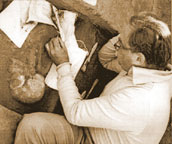 Major excavations had not been carried out for forty years until 1986 when the late George Dales of the University of California at Berkeley established the Harappan Archaeological Project, or HARP. This multidisciplinary study effort consists of archaeologists, linguists, historians, and physical anthropologists.
 Since the establishment of HARP, Jonathan Mark Kenoyer has served as co-director and field director of the project. Kenoyer was born in Shillong, India, and spent most of his youth there. He went on to receive his advanced degrees from the University of California at Berkeley. He is now a professor of Anthropology at the University of Wisconsin-Madison, and teaches archaeology and ancient technologies. Kenoyer's main focus has been on the Indus Valley civilization's where he has conducted research for the last 23 years. Ever since he was a young graduate student, Kenoyer was particularly interested in ancient technology. He has done a great deal of work in trying to replicate processes used by ancient people in the production of jewelry and pottery. One of his first efforts in replicating shell bangle making was then co-authored with George Dales and published in an article. His doctorate studies were based upon this research, and his dissertation is a milestone in the field of experimental archaeology and ethnoarchaeology, besides being the definitive study of Harappan shell working. (4)
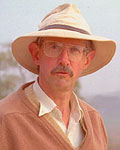 Today, Kenoyer is assisted by co-director Richard Meadow of Harvard University and Rota Wright of New York University (A. C.I.V.C. Kenoyer preface) Kenoyer uses a contextual archaeological approach. His work is characterized by the use of cold evidence to draw the outlines of this ancient civilization.
Although , Harappa was undoubtedly occupied previously, it was between 2600-1900 B.C. that it reached its height of economic expansion and urban growth. Radio carbon dating, along with the comparison of artifacts and pottery has determined this date for the establishment of Harappa and other Indus cities. This began what is called the golden age of Harappa. During this time a great increase in craft technology, trade, and urban expansion was experienced. For the first time in the history of the region, there was evidence for many people of different classes and occupations living together. Between 2800-2600 B.C. called the Kot Diji period, Harappa grew into a thriving economic center. It expanded into a substantial sized town, covering the area of several large shopping malls. Harappa, along with the other Indus Valley cities, had a level of architectural planning that was unparralled in the ancient world. (5) The city was laid out in a grid-like pattern with the orientation of streets and buildings according to the cardinal directions. To facilitate the access to other neighborhoods and to segregate private and public areas, the city and streets were particularly organized. The city had many drinking water wells, and a highly sophisticated system of waste removal. All Harappan houses were equipped with latrines, bathing houses, and sewage drains which emptied into larger mains and eventually deposited the fertile sludge on surrounding agricultural fields. It has been surprising to archaeologists that the site layouts and artifact styles throughout the Indus region are very similar. It has been concluded these indicate that there was uniform economic and social structure within these cities. (6)
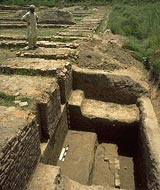
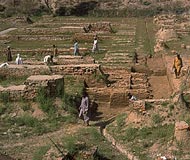
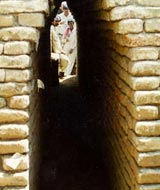
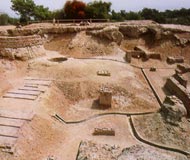
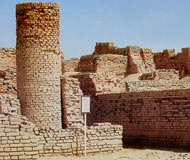
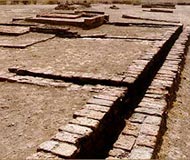
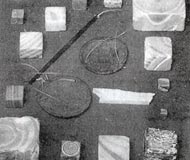 Other indicators of this is that the bricks used to build at these Indus cities are all uniform in size. It would seem that a standard brick size was developed and used throughout the Indus cities. Besides similar brick size standard weights are seen to have been used throughout the region as well. (7) The weights that have been recovered have shown a remarkable accuracy. They follow a binary decimal system: 1, 2, 4, 8, 16, 32, up to 12,800 units, where one unit weighs approximately 0.85 grams. Some of the weights are so tiny that they could have been used by jewelers to measure precious metals. ( 8)
Ever since the discovery of Harappa, archaeologists have been trying to identify the rulers of this city. What has been found is very surprising because it isn't like the general pattern followed by other early urban societies. It appears that the Harappan and other Indus rulers governed their cities through the control of trade and religion, not by military might. It is an interesting aspect of Harappa as well as the other Indus cities that in the entire body of Indus art and sculpture there are no monuments erected to glorify, and no depictions of warfare or conquered enemies. ( 9) It is speculated that the rulers might have been wealthy merchants, or powerful landlords or spiritual leaders. Whoever these rulers were it has been determined that they showed their power and status through the use of seals and fine jewelry.
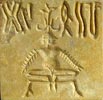
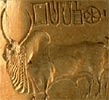
Seals are one of the most commonly found objects in Harappan cities. They are decorated with animal motifs such as elephants, water buffalo, tigers, and most commonly unicorns. Some of these seals are inscribed with figures that are prototypes to later Hindu religious figures, some of which are seen today.
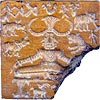
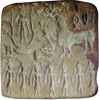
For example, seals have been recovered with the repeated motif of a man sitting in a yogic position surrounded by animals. This is very similar to the Hindu god of Shiva, who is known to have been the friend of the animals and sat in a yogic position. These seals are known as the Shiva seals. Other images of a male god have been found, thus indicating the beginnings of Shiva worship, which continues to be practiced today in India. (10)
 This is an interesting point because of the accepted notion of an Aryan invasion. If Aryan's had invaded the Indus Valley, conquered the people, and imposed their own culture and religion on them, as the theory goes, it would seem unlikely that there would a continuation of similar religious practices up to the present. There is evidence throughout Indian history to indicate that Shiva worship has continued for thousands of years without disruption. [cf. harappan cultural continuity]
The Aryan's were supposed to have destroyed many of the ancient cities right around 1500 B.C., and this would account for the decline of the Indus civilization. However the continuity of religious practices makes this unlikely, and other more probable explanations for the decline of the Harappan civilization have been proposed in recent years; such as climate shifts which caused great droughts around 2200 B.C., and forced the abandonment of the Indus cities and pushed a migration westward. Recent findings have shown that the Sumerian empire declined sharply at this time due to a climate shift that caused major droughts for several centuries. (11) The Harappans being so close to Sumer, would in all probability have been affected by this harsh shift in climate.
Many of the seals also are inscribed with short pieces of the Indus script. These seals were used in order to show the power of the rulers. Each seal had a name or title on it, as well as an animal motif that is believed to represent what sort of office or clan the owner belonged to. The seals of the ancient Harappan's were probably used in much the same way they are today, to sign letters or for commercial transactions. The use of these seals declined when the civilization declined.
In 2001 Kenoyer's excavations unearthed a workshop that manufactured seals and inscribed tablets. This was significant in that combined with the last 16 years of excavations, it provided a new chronology for the development of the Indus script. Previously, the tablets and seals were all grouped together, but now Kenoyer has been able to demonstrate that the various types of seals and tablets emerged at different times. The writing on the seals and tablets might have changed as well through the years. Kenoyer as well as others are trying to conclude when the dates of the script changes were. The revision of this chronology may greatly aid in the decipherment of the script. (12) There has been attempts at deciphering this script, and the results are not widely agreed upon, and its still a point of controversy.
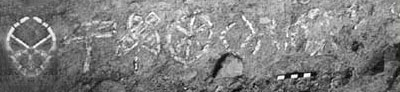

[Reading from right to left]

The ruling elite controlled vast trade networks with Central Asia, and Oman, importing raw materials to urban workshops. There is even evidence of trade with Mesopotamia, for Harappan seals and jewelry have been found there. Harappa, along with other Indus cities, established their economic base on agriculture produce and livestock, supplemented by the production of and trade of commodities and craft items. Raw materials such as carnelian, steatite, and lapis lazuli were imported for craft use. In exchange for these goods, such things as livestock, grains, honey and clarified butter may have been given. However, the only remains are those of beads, ivory objects and other finery. What is known about the Harappan's is that they were very skilled artisans, making beautiful objects out of bronze, gold, silver, terracotta, glazed ceramic, and semiprecious stones. The most exquisite objects were often the most tiny. Many of the Indus art objects are small, displaying and requiring great craftsmanship.


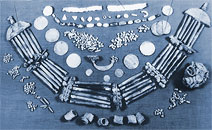
The majority of artifacts recovered at Harappa and Mohenjo Daro have been that of crafted objects. Jonathan Kenoyer has been working to recreate many of the craft technologies used by these people. He has successfully recreated the process by which the Harappan's created faience. The process of creating faience ceramics is very complex and technical. It requires such processes as the grinding and partial melting of quartz, fusion aids, and a consistent high temperature of 940 Celsius. A discovery in 2001 of a faience producing workshop revealed that the type of kiln used was very different from what they had thought. As no kiln was discovered in the workshop, Kenoyer suspected that the ancient crafts people had used a kiln assembled from two firing containers. This formed a smaller kiln that was unlike the usual large firing containers. Along with some of his students Kenoyer replicated the process of creating faience using similar tools that the Harappan's had. The result was similar to that of the Harappan's. This showed that the canister-kiln type was a very efficient way of producing faience. (13) Interestingly , Kenoyer has noticed that many of the same firing techniques and production procedures are used today in India and Pakistan as they were thousands of years ago. This is another point indicating that there was a continuity in culture that has been mostly unchanged for thousands of years.
The late George F. Dales, who was a long time mentor of Kenoyer's and established HARP, has said regarding the Aryan invasion theory:
"Nine years of extensive excavations at Mohenjo-Daro ( which seems to have been rapidly abandoned) have yielded a total of some 37 skeletons which can be attributed to the Indus period. None of these skeletons were found in the area of the fortified citadel, where reasonably the last defense of this city would have taken place." He further states that "Despite extensive excavations at the largest Harappan sites, there is not a single bit of evidence that can be brought forth as unconditional proof of an armed conquest and destruction on the scale of the supposed Aryan invasion." (14)
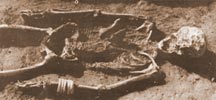 The skeletal remains found at Harappan sites that date from 4,000 years ago, show the same basic racial types as are found today in Gujarat and Punjab, India. This is interesting, because if a foreign light-skinned people entered and took over, it would seem likely that there would be genetic evidence for this. The long continuity of ethnic groups in this region would indicate that the people living there had not seen an influx of a different ethic group that would have mixed with their own. (15)
After 700 years the Harappan cities began to decline. This is generally attributed to the invasion of a foreign people. However, it now believed by Kenoyer and many other archaeologists that the decline of the Indus cities was a result of many factors, such as overextended political and economic networks, and the drying up major rivers. These all contributed to the rise of a new social order. There is archaeological evidence that around the late Harappan phase, from 1900-1300 B.C. the city was not being maintained and was getting crowded. This suggests that the rulers had were no longer able to control the daily functioning of the city. Having lost authority, a new social order rose up. Although certain aspects of the elites culture, seals with motifs and pottery with Indus script on it, disappeared, the Indus culture was not lost. (16) It is seen that in the cities that sprung up in the Ganga and Yamuna river valleys between 600-300 B.C., that many of their cultural aspects can be traced to the earlier Indus culture. The technologies, artistic symbols, architectural styles, and aspects of the social organization in the cities of this time had all originated in the Indus cities. (17) This is another fact that points to the idea that the Aryan invasion did not happen. The Indus cities may have declined, for various reasons, but their culture continued on in the form of technology, artistic and religious symbols, and city planning. Usually, when a people conquer another they bring with them new ideas and social structures. It would seem that if indeed Aryan's invaded India, then there would be evidence of a completely different sort of religion, craft making, significant changes in art and social structure. But none of this has been found. There appears to be an underlying continuity in the culture of India, and what changes have occurred are due to largely internal factors. This is an idea shared by many prominent archaeologists, such as Kenoyer, George Dales, Jim Shaffer, and Colin Renfrew.

The Aryan's are supposed to have brought the Vedic culture to India. These people and their literature is believed to have then originated after the decline of the Indus Valley civilizations. The Vedas have been dated as being written some time after the Aryan's supposedly invaded, somewhere between 1500-1200 B.C. Many of the Indus sites have been found along the banks of the now dried up Sarasvati river. This river is mentioned throughout the Vedas (18) Recent geological investigations has shown that the Sarasvati was once a very large river (as well as satellite photos of the indus-sarasvati river basin), but dried up around 1900 B. C. due to tectonic movements. (19) The Vedas, however speak of the Sarasvati as a very large and flowing river. If the dating of the Vedic literature is correct, than there is a discrepancy because the Sarasvati river dried up before the Vedas were supposed to have been written. This is an interesting situation. It might seem possible then, that with other evidence showing that there was no influx of an invading people, that the Vedas were then written by the people of the Indus Valley.
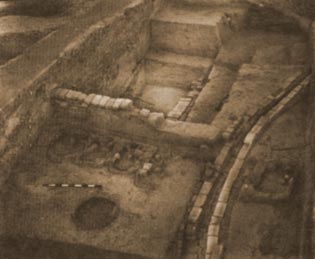 Another point that might indicate the Harappan's being a Vedic culture is the discovery of fire altars at several Indus sites. Fire rituals and sacrifice were an important part of Vedic religious practices. But what was significant about these alters, is that they were aligned and constructed in the same manner as later discovered altars were. The fire altars were then Vedic in construction indicating that the Harappan's were a Vedic culture.
The idea that there wasn't in fact an Aryan invasion is supported on many levels, as I have tried to demonstrate. Even today, it is seen in India the legacy of these Indus cities in the traditional arts and crafts, and in the layout of houses and settlements. If there really was an invasion of a people that completely obliterated this other culture, then the many striking similarities we see today in the continuity of Indian culture is certainly most curious. The remains of the Indus civilization are enormous, and most of them are yet to be excavated. There are whole cites that have yet to be excavated, like the largest known Indus culture site of Ganweriwala, in the Cholistan desert of Pakistan. No doubt the continuing excavations will lend more insight into the world of this enigmatic civilization.
Bibliography
1. Indus Valley Civilization (1990) In Encyclopedia Britannica. (p. 302). Chicago, IL.
2. Kenoyer, Jonathan. (July 2003) Uncovering the keys to lost Indus cities. Scientific American. pg 71.
3. Kenoyer, Jonathan. (1998). Ancient Cities of the Indus Valley Civilization. Oxford, New York. Oxford University Press. 20-21
4. Ibid. Preface.
5. Ibid. 52 .
6. Kenoyer, Jonathan. (July 2003) Uncovering the keys to lost Indus cities. Scientific American. pg 71.
7. http://www.Harappa.com/har/har1.html)
8. Feurstein, George, Kak, Subash, Frawley, David. (2001) In Search of the Cradle of Civilization. Wheaton, Illinois. Quest Books. 83.
9. Kenoyer, Jonathan. (July 2003) Uncovering the keys to lost Indus cities. Scientific American. pg 71
10. Knapp, Stephen. (2000). Proof of Vedic Culture's Global Existence. Detroit, Michigan. The World Relief Network. 42.
11. Rajaram, N.S, Frawley, David, (2001) Vedic Aryans and the Origins of Civilzation: a literary and scientific perspective. New Delhi, India. Voice of India. pg. 304.
12. Kenoyer, Jonathan. (July 2003) Uncovering the keys to lost Indus cities. Scientific American. pg. 74
13. Kenoyer, Jonathan. (1998). Ancient Cities of the Indus Valley Civilization. Oxford, New York. Oxford University Press. pg. 97.
14. Dales, George F., The Mythical Massacre at Mohenjo-Daro.
15. Knapp, Stephen. (2000). Proof of Vedic Culture's Global Existence. Detroit, Michigan. The World Relief Network. pg. 43.
16 Kenoyer, Jonathan. (July 2003) Uncovering the keys to lost Indus cities. Scientific American. pg. 67
17. Kenoyer, Jonathan. (1998). Ancient Cities of the Indus Valley Civilization. Oxford, New York. Oxford University Press. 19.
18. Frawley, David, The Myth of the Aryan Invasion of India. The India Times.
19. Feurstein, George, Kak, Subash, Frawley, David. (2001) In Search of the Cradle of Civilization. Wheaton, Illinois. Quest Books. pg. 91.