
by
Robin Winter
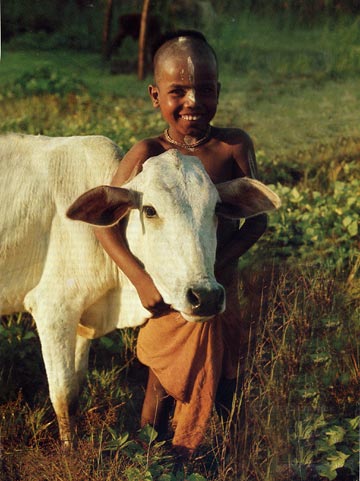
 The world over, the term "sacred cow" has come to mean any stubborn loyalty to a long-standing institution which impedes natural progress. The term originates in India, where the cow is said to be literally worshiped, while thousands of humans suffer from undernourishment. The common, popular view of India in the West is that of an underdeveloped nation steeped in superstition. Overpopulated, overcrowded, undereducated, and bereft of most modern amenities, India is seen to be a backward nation in many respects by "progressive" Western civilization. "If only India would abandon her religious superstitions and kill and eat the cow!" Over several decades many attempts have been made by the "compassionate" West to alleviate unfortunate India's burden of poor logic, and to replace her superstitions with rational thinking.
Much of the religious West finds common ground with the rationalists, with whom they otherwise are usually at odds, on the issue of India's "sacred cow." Indeed, worshiping God is one thing, but to worship the cow while at the same time dying of starvation is a theological outlook much in need of reevaluation. Man is said to have dominion over the animals, but it would appear that the Indians have it backwards.
Popular opinion is not always the most informed opinion; in fact, this is usually the case. The many attempts to wean India from the nipple of her outdated pastoral culture have all failed. After 200 years of foreign occupation by the British, and after many subsequent but less overt imperialistic attempts, we find that although India has changed, the sacred cow remains as sacred as ever. In all but two Indian states, cow slaughter is strictly prohibited. If legislation were passed today to change that ruling, there would be rioting all over India. In spite of considerable exposure to Western ideas, one late Indian statesman said, when asked what he thought of Western civilization, "I think it is a good idea. When will they begin?"
An unbiased look at perhaps the longest-standing culture of the world, its roots and philosophy, may help us to see things a little more as they are — even about our own way of life. Sometimes we have to stand back to get the full picture. It is a natural tendency to consider one's own way the best, but such bull-headedness may cause us to miss seeing our own shortcomings. An honest look at the headlines of our home town newspaper may inspire us to question exactly what it is we are so eager to propound.
Perhaps the most appalling aspect of the Western technological influence on India is found in the country's few "modern" cities. Bombay, Calcutta, Delhi, and other cities can be most frustrating to the average Westerner. Crude attempts at modernization can be worse than none at all. Although India's technology lacks the polish and sophistication of the West, its employment in crude fashion nonetheless brings all of the adverse effects of a sophisticated form of the same amenities.
Real India is rural India. Village life accounts for the bulk of India's population of 700 million, and best illustrates the nation's ancient culture. The simplicity of India is often mistaken for ignorance, and her peacefulness mistaken for complacency. The serenity of Indian village life is overlooked or mislabeled by those who in the name of progress may really only be operating under the axiom of "misery loves company." Perhaps the people of India live as they do for a good reason: much of what goes along with Western "progress"—the mental anguish which causes us to do the most bizarre things that make many cities living hells—is relatively absent in India's rural lifestyle.
It is particularly difficult for Westerners to appreciate India's worship of the cow. After all, we live in the land of the hamburger. The "American" restaurant abroad is McDonald's. "Ole McDonald had a farm /Did it ever grow!" Western economists often contend that beef alone can solve India's food problems and lay a foundation for a lucrative export trade. This has caused cow worship and cow protection to come under attack for centuries. Cow protection has been called a "lunatic obstacle" to sensible farm management.
India's cow is called the zebu, and an investigation of the controversy surrounding her brings us to the heart of village life in India. The average landholder in India farms approximately one acre. This is nowhere near enough land to warrant the purchase of a tractor. Even if the size of the land plots were increased to make the purchase of machinery cost-effective, the unique weather, a five-season year including the monsoon, would quickly render the tractor useless. After the monsoons, the soil is too soft for planting and must be quickly and efficiently prepared before the soon-to-follow intense heat brings an end to the very short growing season. The loss of even one day will considerably affect the overall yield. The zebu bullocks are ideal in this connection for they can easily plow the soft earth without overly compacting the soil as would heavy machinery.
Farming in India is a family affair, and the labor-intensive approach to cultivation involves everyone. This helps to sustain the family unit, which is sometimes considered to be the wealth of a nation. The staples of the diet are grains: wheat and rice. Most of India is vegetarian. While the bull plows the field, helping to provide the grains, the cow supplies milk from which many dairy products are produced. Day to day, year after year, the cow and bull are the center of rural Indian life.
According to Frances Moore Lappe in her best-seller, Diet for a Small Planet, "For every sixteen pounds of grain and soy fed to beef cattle in the United States, we only get one pound back in meat on our plates. The other fifteen pounds are inaccessible to us, either used by the animal to produce energy or to make some part of its own body that we do not eat (like hair or bones), or excreted. Milk production is more efficient, with less than one pound of grain fed for every pint of milk produced. (This is partly because we don't have to grow a new cow every time we milk one.)" If India, with its already strained resources, were to allocate so much more acreage for the production of beef, it would be disastrous. Advocates of modernization maintain that with the application of the latest farming techniques, the yield per acre would gradually increase, thus making it possible for beef to be introduced over a period of time. Such advocates contend that with the introduction of beef into the Indian diet, the population's health would increase, thus furthering productivity. However, it is interesting to note that although India is far from being free of disease, its principal health problems are a result of urban overcrowding and inadequate sanitation and medical facilities. Whereas high blood pressure, heart disease, arthritis, and cancer constitute the greatest health threats in the West, the Indian people are practically free from these afflictions. So the "fact" that India's health would increase with the introduction of beef into the diet is not likely to overcome the "superstition" of the people's religious beliefs which prohibit them from eating meat.
The religious "superstitions" of India are based on the Vedas, which constitute the most voluminous body of literature in the world. The Vedas and their corollaries deal elaborately with theism, describing many gradations of the theistic idea. The idea that one should not eat meat, although central to Hindu philosophy, is only a secondary theme. To a large extent it amounts only to common sense and sensitivity. It is from this basis of sensitivity, an indicator of healthy consciousness, that higher spiritual principles can be appreciated. Actually, the Vedas agree with the West's contention that man has dominion over the animals; however, the West's way of dealing with its dependents is revolting to Indians. After all, we have dominion over our children and ofttimes elders as well, but would we be justified in slaughtering them for food? We become incensed if someone even abuses our dog!
The Vedas do not teach that the cow is superior to the human form of life and therefore worshipable. Rather, the she gives so much practical help to human society that she should be protected. Her assistance frees mankind from much of the struggle of life, thereby providing us with more time for spiritual pursuits. Although modern technology may be said to do the same, the fact is that it actually complicates man's life more and more and distracts him from more simple living and high spiritual thinking. We may become so mechanistic that we can fool ourselves into believing that cows or pets have no feelings.
For India, the cow represents the sacred principle of motherhood. She symbolizes charity and generosity because of the way she distributes her milk, which is essential for the nourishment of the young.
India's critics have pointed out that although Indian village life may be simple, it is a marginal existence; it is a life of little surplus. If a farmer's cow turns barren, he has lost his only chance of replacing the work team. And if she goes dry, the family loses its milk and butter. However the situation is not as bad as the technologically advanced may think. In village life, people are more interdependent. Helping one's neighbor is also considered sacred. Sharing is commonplace. All of the father's male friends are affectionately referred to by the sons and daughters as "uncle", while all of the village women are seen as mother. Often the responsibility of caring for and nursing the young is shared by several mothers.
Perhaps the heaviest criticism of the pastoral culture of India is directed at the insistence of the farmers on protecting even sick and aged cows. Westerners find this to be the height of absurdity. At least they could be killed and eaten or sold. But no. Animal hospitals or nursing homes called goshallas, provided by government agencies or wealthy individuals in search of piety, offer shelter for old and infirm cows. This is thought to be a luxury that India cannot really afford, as these "useless" cows are seen to be but competitors for the already limited croplands and precious foodstuffs. The fact is, however, that India actually spends a great deal less on their aging cattle than Americans spend on their cats and dogs. And India's cattle population is six times that of the American pet population.
The Indian farmer sees his cattle like members of the family. Since the farmers depend on the cattle for their own livelihood, it makes perfect sense both economically and emotionally to see to their well-being. In between harvests, the cattle are bathed and spruced up much like the average American polishes his automobile. Twice during the year, special festivals are held in honor of the cows. These rituals are similar to the American idea of Thanksgiving. Although in principle the same, there is a basic difference in the details of how we treat the turkey and how the more "primitive" Indians treat their cows.
India cares for over 200 million zebus. This accounts for one-fifth of the world's cattle population. Critics say that if India does not eat her cows, the cows will eat India. Exasperated critics feel that even the cow is underfed. However, in more recent years, India's critics have come to agree that she is essential to India's economy. Cattle are India's greatest natural resource. They eat only grass --which grows everywhere--and generates more power than all of India's generating plants. They also produce fuel, fertilizer, and nutrition in abundance. India runs on bullock power. Some 15 million bullock carts move approximately 15 billion tons of goods across the nation. Newer studies in energetics have shown that bullocks do two-thirds of the work on the average farm. Electricity and fossil fuels account for only 10%. Bullocks not only pull heavy loads, but also grind the sugarcane and turn the linseed oil presses. Converting from bullocks to machinery would cost an estimated $30 billion plus maintenance and replacement costs.
The biggest energy contribution from cows and bulls is their dung. India's cattle produce 800 million tons of manure every year. The Vedas explain that dung from cows is different from all other forms of excrement. Indian culture insists that if one comes in contact with the stool of any other animal, they must immediately take a bath. Even after passing stool oneself, bathing is necessary. But the cow's dung, far from being contaminating, instead possesses antiseptic qualities. This has been verified by modern science. Not only is it free from bacteria, but it also does a good job of killing them. Believe it or not, it is every bit as good an antiseptic as Lysol or Mr. Clean.
Most of the dung is used for fertilizer at no cost to the farmer or to the world's fossil fuel reserves. The remainder is used for fuel. It is odorless and burns without scorching, giving a slow, even heat. A housewife can count on leaving her pots unattended all day or return any time to a preheated griddle for short-order cooking. To replace dung with coal would cost India $1.5 billion per year.
Dung is also used for both heating and cooling. Packed on the outside walls of a house, in winter it keeps in the heat, and in summer produces a cooling effect. Also, unlike the stool of humans, it keeps flies away , and when burned, its smoke acts as a repellent for mosquitoes.
When technocrats were unable to come up with a workable alternative, they came up with a new argument for modernization. They suggested that the cattle culture be maintained, but that it should be done in a more efficient manner. Several ambitious programs were initiated using pedigree bulls and artificial insemination. But the new hybrids were not cheap nor were they able to keep up the pace with the zebus. The intense heat of India retired many of them well before old age. Although they produced more milk, this also created more problems, because there was no efficient system for distributing the surplus of milk throughout India's widespread population.
India's system of distribution is highly decentralized. Although the solution seemed simple, modernization again met its shortcomings. With bottling plants, pasteurization, and other sophisticated Western methods of distribution, it was thought that all of India could have fresh, pure milk. Behind the automats set up for the distribution of powdered milk, milk, and cream was the expectation that in time, people would begin to appreciate the abundant rewards bestowed by these new modern deities of technology, and worship of cows would gradually disappear. But in the end it was modernization that failed to prove its value.
Pasteurization proved to be a waste of time and money for Indians, who generally drink their milk hot, and thus boil it before drinking. With the absence of modern highways and the cost of milking machines and other necessities of factory dairy farming, it was seen to be impractical to impose the Western dairy system on India; the cost of refrigeration alone would make the price of milk too expensive for 95% of India's population.
Eventually, after repeated attempts to modernize India's approach to farming—and in particular its attitude toward its beloved zebus—it became clear that these technological upgrades were not very well thought out. They were not to replace a system that had endured for thousands of years; a system not only economically wise, but one that was part of a spiritually rich heritage. On the contrary, it may well be time to export the spiritual heritage of India to the West, where technology continues to threaten the tangible progress of humanity in its search for the deeper meaning of life.