
Vedic Discoveries: Krsna and Balarama in Greece
" The people of Marathon worship both those who died in the fighting, calling them 'heroes,' and [a semi-divine being called] 'Marathon,' from whom the country derives its name, but also Heracles . . . . They say also that a man took part in the battle who looked and was dressed like a farmer. He slaughtered many of the Persians with his plowshare, and when everything was over he disappeared. But when the Athenians consulted the oracle, the god would not tell them anything except to honor 'Echetlaeus' [i.e. the man with the plowshare] as a hero."
However, the worship of Sankarsana appears to have been quite popular in the fourth century BCE and Megasthenes seems to refer to him. The Greek writer referring to Dionysos clearly states that the Indians speak of three individuals of this name appearing in different ages and they assign suitable achievements to each of these. The oldest of these was Indos, apparently the same as Indra, "who crushed grapes and discovered the use of the properties of wine." He further states that Dionysos also found out the method of growing figs and other fruit trees and taught this knowledge to others whence he was called Lenaios. This may be a corruption of Lingayasas or Lingin, a name for Siva. The third god spoken of in this context is Katapogon; and Megasthenes states that he was so named because it is a custom among Indians to grow their beards with great care. Katapogon is evidently the same as Kapardin, meaning one wearing braided and matted hair. The epithet is usually applied to Siva, but it may have been applied to Sankarsana also since the worshippers of Sankarsana, as we have noted earlier, wore braided (jatila) hair.
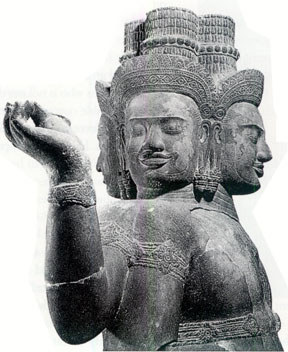
Dionysus
 At any rate, the three gods who could have been confused with Dionysos by Megasthenes are apparently Indra, Siva and Sankarsana, all the three are associated with wine and renowned for their bacchanalian habits. Arrian informs us that before the coming of Dionysos, Indians were nomads subsisting on the bark of the trees known as tala (fan-palm) and that when Dionysos came to India he taught them to sow the land, and it was he who "first yoked oxen to the plough and made many Indian husbandmen and gave the people the seeds of cultivated plants."
 The description eminently suits the agricultural divinity Sankarsana, the wielder of the plough, with the fan-palm as his emblem. Arrian also writes that according to the Indians, Dionysos was earlier than Herakles by fifteen generations; and, as Herakles is generally identified with Vasudeva-Krsna in the popular mythology of the fourth century B.C., the Krishna and Baladeva legends had not yet acquired the final shape in which they are presented to us in the Mahabharata and the Puranas."
From ‘Pausanias, Description of Greece’, 1.32.4, quoted in George Luck’s ‘Arcana Mundi: Magic and the Occult in the Greek and Roman Worlds’. Baltimore, Johns Hopkins Univ. Press, (1985)
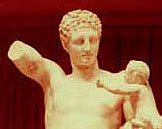
Herakles
 "It is pointed out in the Bhagavad-gita that Arjuna often addresses Vasudeva Krsna as Visnu. But the date of this work is highly controversial. It is closely linked with that of the epic in its present form. The assertion of another scholar (Pusalkar) about Megasthenes "The Greek ambassador definitely states that Krsna was regarded as an incarnation of Visnu" is evidently baseless. All that Megasthenes is reported to have said is "This Herakles is held in especial honour by Sourasenoi, an Indian tribe who possess two large cities Mathora and Cleisobora and through whose country flows a navigable river called Iobares." Herakles has been identified with Vasudeva Krsna and Sourasenoi with the Surasena Yadavas. The use of the words "especial honour" clearly indicates that Krsna was still a minor divinity, far from being the supreme god that he becomes with his identification with Narayana-Visnu; by no stretch of the imagination can it be construed to refer to Narayana-Visnu.

 In the early centuries preceding and succeeding the Christian era, the entry of foreign tribes into India produced a favourable impact on the cults of Vaisnvaite and Saivite divinities, which, on the whole, enjoyed the support of the foreigners. The Greeks identified Krsna with Herakles and Sankarsana with Dionysos, and it is no wonder that they were favourably inclined to their worship. The Besnagar inscription describes the Greek ambassador Heliodorus as a Bhagavata who dedicated a Garuda banner to Lord Vasudeva.
The earliest epigraphic evidence for the existence of the Bhagavata cult is found in Madhya Pradesh. The discovery of the Garuda pillar inscription of Besnagar is a landmark in the history of Bhagavatism. The inscription records the erection of a Garuda standard in honour of Vasudeva, the god of gods, by a Greek ambassador Heliodorus who describes himself as a Bhagavata (see Heliodorus Column), and a resident of Taksasila. The ambassador came from the Greek king Antialcidis to Kautsiputra Bhagabhadra identified with the fifth Sunga king, and the record is dated in the fourteenth year of his reign, approximating to c. 113 B.C."
Suvira Jaisval, The Origin and Deveopment of Vaisnavism (Munshiram Manoharlal, 1967)
The Times of India reports a major archeological find of structures dating back to the Mahabharata period:
"Archaeologists have discovered ancient monuments, dating back to the Mahabharat period, during excavations carried out near Gwalior. The excavations, carried over a period of five months, were suspended on July 7 due to the monsoon.' The archaeologists believe that Gwalior town was established in the first century AD and not in eighth century AD, as was believed earlier. They came to this conclusion following the discovery of a large community structure at the Gwalior fort.
Superintending archaeologist of Madhya Pradesh A.K. Sinha said the excavations had exposed a 1.7-metre thick burnt brick wall having a height of about three metres. Mr Sinha told TOINS that the wall appeared to be a part of a large community structure, possibly a huge reservoir. On the basis of the ceramic industry and workmanship, the structure was dated to the first century AD. Though Naga coins dating to the 2nd or 3rd century AD were found from the surface on earlier occasions from Gwalior fort, this is the first time that any structural remains dating back to the beginning of the Christian era has been found. The ASI plans to carry out more excavations after the monsoon.
A Mahabharat period site has also been found at Kotwar, about 40 km from here. The site is located about eight km from Noorabad, a sub-divisional town on the Agra-Mumbai highway. The excavations, which started in February last, will be resumed after the monsoon. According to the archaeologists, the site has been identified with Kamantalpur, which was derived from the name of its founder, Kamant, father of the mythological character in the Mahabharat, Kunti, who later became the mother of the five Pandva brothers.
The site has a 18 to 20-metre-high mound and covers an area of about 2.5 sq km, according to Mr Sinha. He said the site had also been identified as one of the chief cities of the nine., Naga kings.The archaeologists claim that the digging at Kotwar had led to the recovery of painted greyware which had been interpreted by noted archaeologists B.B. Lal, as belonging to the Mahabharat period.
During the excavations at Kotwar, black and redware and black slipped ware, typical ceramic industries which pre-dated even the painted greyware (1100-800 BCE), were found from the lowest levels. The remains found at Kotwar have been sent to the Physical Research Laboratory and the Birbal Sahni Institute of Botany for precise dating. The excavations also revealed a number of ring wells which date back to the later half of the first millennium BCE."